It’s hikin’ time in Prescott, AZ.

IMG_0786Almost any time of year is a great time for hiking in Prescott. But springtime is especially nice. The temperature is in the sixties, the sky is a bright blue with puffs of white clouds, and signs of new growth are visible everywhere.

A trail I would recommend to you is the Granite Gardens. I call it 1.2 miles of awesome! To reach the trailhead, drive north on highway 89 through the Granite Dells to Granite Gardens Drive. It is across from Granite Gate Senior Living. From the parking area, walk east and use the bridge to cross Granite Creek. The beginning of the trail will be on your left as you walk up the road and goes sharply up. As you reach the crest of the hill and go over the top, you will have an excellent view of a small dam. It was used to divert water into a pipeline that carried water to the Chino Valley Irrigation Project. Another dam farther downstream provided water for a freshwater swimming pool at the Dells Resort. My mother has many memories of that pool. I think I might have gone there with my aunt and uncle as a child, but I don’t really remember it. The pool was closed in 1971.

IMG_0285Continuing along the trail, you will come to a stairway. Reaching the top, you will enter the majestic granite portion of the hike. Following the white dots across the rocks, you climb over and down the granite face.



IMG_0320From there the trail leads to Castle Rock. Views are spectacular in every direction as you continue along this loop of the trail.

On the next part of the trail, we became a little lost, but were glad we did. Otherwise, we would have missed the room built into the rock. The metal door said, “IMG_0302Do not come in,” but who could resist?

As the trail continued, we climbed up the side of what is called the Rock Stacker. It didn’t really take a great deal of imagination to figure out why it was called that.

From there, the trail led to an underground grotto. Giant boulders were wedged tightly into a crevice. The trail took us under the boulders, any one of which could have easily crushed us to death, had they not been so firmly in place. For part of the trail we had to squeeze between some rocks.  It was a daring adventure that no one should miss.

IMG_0334After wiggling our way out at the other end, we were treated to more spectacular views of the granite rocks as we climbed back down. From there, we walked across a meadow and back to the creek. We left our little refuge and returned to civilization, still amazed at all that we had seen on the short but incredible hike.

“One We Are the Girls”

Scan_20150316The mother-daughter relationship is a special kind of phenomenon that is difficult to explain. It is a relationship that changes over time but remains an important part of a woman’s life. The father-daughter relationship is also wonderful, but mothers and daughters can share a kind of intimacy that father’s can’t easily grasp.  With Kirstin and me, we have shared a special bond that I believe began with caring for Kirstin in the hospital when she had meningitis. It was strengthened further during the time we spent together when she was in preschool. There has never been a time when Kirstin and I haven’t been friends. I know that many mothers and daughters go through rough periods, when they struggle to define their respective roles. Kirstin and I struggled a little, but I consider it one of the trade-offs that her teen years were pleasant ones. This is especially  amazing when you consider that besides being her mother, I was her teacher during four years of high school.

Craig and Michael always seemed to be busy with work or scouting, doing guy things. So Kirstin and I spent a lot of time together. We played games and Barbies and read stories. We developed out own cheer. It was adapted from one of the cheers performed at the football games for the high school where I teach. It went, “One, we are the girls. Two, we do it right. Three, we are number one . . . We are the girls.”

Each summer, the local movie theater had a weekly children’s movie. This became our summer ritual, and every week Kirstin, Sherry Baby (her Cabbage Patch doll) and I would go to the movies. Kirstin and Sherry always wore matching outfits, and the workers at the theater would watch for us and say, “Here they come.” Due to Kirstin’s maturity level, she enjoyed the type of movies they were showing, so we continued with this routine much longer than most moms and daughters would. We called it our “girls’ day out.”

Kirstin’s side of the story:

I like spending time with both my parents. Sometimes we invite our guys, Dad and my fiancé David, to come along. We go to the movies and lunch on a double date. Sometimes we go hiking or bowling. I look forward to going on a girls’ day out with my mom. In fact, we had one today. We went shopping at the mall. I bought some cute clothes. Mom helped me pick them out. We went to lunch and then to Walmart to buy my groceries. I hope I never get too old for a girls’ day out.

From This Little Light of Mine, A woman with Down syndrome shines brightly in the world. This book is available on Amazon


The night God erased my manuscript

miracle mileI had been working hard on the second Handy Helpers book all day–first making some important revisions and then focusing on chapter ten. After dinner, I returned to work on it again, eager to finish the chapter. With chapter ten not quite completed, I was forced to quit as my mind was shutting down. Suddenly, the computer screen went blank. I stared at the white screen for a few seconds before deciding that I must have hit a function key and opened a new file. When I clicked the x to close the file, I was asked, as usual, if I wanted to save the changes. Just as I clicked “yes,” I realized I had not opened a new file, but I had actually deleted everything–thirty thousand words gone in an instant!

My initial shock was eased a little as I remembered that every night at eleven o’clock my writing was automatically backed up on a thumb drive. I hadn’t lost everything–only my work from that day. Still feeling the loss and wondering if I would be able to recall all that I had written that day, I went to bed.

The next day I was able to retrieve my backed up work and  easily return to the parts of my manuscript where I made changes. With all the changes completed, I turned my attention to the part of chapter ten I had been working on but my mind went completely blank. Try as I might, I could not remember any of the words I had written. As I struggled to think of something to write, it seemed as if a wall had gone up, blocking my thoughts. Finally, in frustration, I gave up.

Later that night, I was reading my homework for an apologetics class I was taking at church. It was a long reading assignment and not terribly interesting, and I was struggling to stay awake. Determined that I was going to finish, I pushed on through the sleepiness. At last, I completed the assigned reading, but for some unknown reason, I continued to read on. My eyes came to rest on a scripture passage–Ephesians 2:8–“For by grace you have been saved through faith, and this is not from you; it is a gift of God; it is not from works, so no one may boast.”

It was at that moment I recognized God’s hand on my writing. I had been working on a part of the book where Beth Anne asks her grandmother to tell her what grace is. Apparently, I hadn’t done an adequate job the first time. Now I had a second chance to get it right. Focusing on the scripture I had been given, I wrote the following:

“There’s one part I don’t understand,” Beth Anne said seriously. “Who is Grace?”

“Grace isn’t a person, honey,” Doris explained. “Grace is . . . grace is . . . well, grace is a gift from God.”

“A gift from God? You mean like a present?”

“Yes, kind of like a present, but the very best present you could ever imagine.”

“If I’m really good, do you think God will give me a present?”

“God doesn’t give us his gifts of grace because we’re good. No one could ever be good enough to earn God’s grace.”

“I don’t understand.” Beth Anne shook her head.

“Let me see if I can explain it.” Doris hesitated for a moment, thinking. “You are holding a gift for your mother, right? Why are you giving her a gift?”

“Because it’s Mother’s Day and I love my mother.”

“Exactly.” Doris let out a sigh. “We give each other gifts to show how much we love each other. But no matter how much love we have, we can never equal the love God has for us. That’s why we can never earn his gifts of grace. He gives us those gifts out of love.”

I’ll never know what words I had written originally. Those words are gone forever–erased by the hand of God. But in their place are words he wanted me to write. I’ll be forever grateful for his gift of grace.


That Guy Named Gus

rheddens_order_delivered_jpgGus Farley is the fun-loving founder of the Bluesky Senior Center. When he and his wife, Barbara, moved to Bluesky from Ohio, only a few families were living there. Gus had retired from his job as a machinist and found himself with lots of time on his hands. At first, he kept busy by whittling, a hobby he learned from his father. But eventually, he looked around for something else to do. Building the senior center in Bluesky was not his idea, but he made it his personal project. Gus and Babs, as everyone called her, worked tirelessly to raise money for the land and building. Their only son had been killed in Vietnam, so the citizens of Bluesky became their family. When Babs was diagnosed with cancer, Gus turned his attention to caring for her. After Babs passed away, the senior center became his refuge. Most days, Gus can be found sitting in the rec room with his cronies, Al, Bert and Norman, telling stories or playing checkers.
When Amber, Laura, and Melissa come to the senior center for the first time to watch Betty’s shuffleboard match, it is Gus who greets them and gives them a quick tutorial on shuffleboard. Later, when they return to sign up as junior volunteers, it is Gus who shows them around the place. After that, the girls come to expect Gus to be there to greet them,  ready with a joke or riddle.

“Tell them a joke before they leave,” Bert told Gus.

“Okay, I’ll try,” Gus said. “Why did the boy eat his homework?”

“Was the boy named Spike?” Amber asked.

“Okay, why did the boy eat his homework?” Laura played along.

“His teacher said it was a piece of cake.”

Although Gus likes to dress up in crazy outfits and join in whatever fun stuff is going on, he does have his serious side. For example, when Amber is feeling guilty about some stunts she pulled to get even with Spike, Gus is there to help her see how much she is valued and loved.

“You know”–Gus became more serious–“I never had a daughter or a granddaughter, but if I did, I’d want her to be just like you.”

“Really?” Amber sounded doubtful. “Laura’s a lot smarter than I am, and Melissa is way prettier. Besides, I mess up a lot.”

“My wife, Barbara, would have loved you,” Gus said. “In some ways you remind me of her.”

“Do I look like her? “When she was younger, I mean?”

“No, you don’t look too much like her, except for your eyes. She had the same warm, deep brown eyes you have. Sometimes there was a little mischief in them like I’ve seen in yours.”

In book three, after Spike’s mishap with the mayor, Spike expects a big lecture from Gus just like the one he received from his parents. Instead, Gus offers him a bit of advice in the form of a Bible scripture, “Do not be overcome by evil, but overcome evil with good.” Gus goes on to give Spike a little project to work on–something that makes all the difference in Spike’s attitude toward Todd.

Gus is the perfect example of Christian charity for the Handy Helpers. He is there to lend a hand when his neighbors are in need–always with a smile. He is patient with Warren Pritchard, who has some memory problems. He is kind to the Clawson sisters who are a little eccentric.  When the Cole children need a home, it is Gus who steps up. That guy named Gus–Bluesky just wouldn’t be the same without him.

The Handy Helpers book series is available at Amazon

The not too easy reader

Scan_20141205 (2)

Friends have asked me how Kirstin learned to read. I tell them she learned in school like everyone else, but there really is more to the story. Some of the ladies at our church wanted to give the credit to Kirstin’s Sunday school teacher. All of a sudden it seemed that Kirstin was able to read the little Sunday school books. Kirstin’s teacher, Mrs. Mobley, was somewhat upset with this version of the story, and rightly so, as she had been working with Kirstin for two years. Of course, Mrs. Mobley deserves the credit. She had a wonderful reading program called Edmark and all the faith in the world that her students could learn to read.

Much of the credit goes to Kirstin herself. I like to tell people that Kirstin learned to read by shear force of will. As her skills improved, she read every word she saw. This meant that she read all the credits at the end of a movie or television program. If we ate in a restaurant, Kirstin had to read the entire menu. Once again we found ourselves being held hostage in restaurants. Kirstin read signs, billboards and posters.  She read and read until she could read almost anything.

Reading has been an important part of my life since I was a small child. Now that I had a daughter who loved reading, I wanted to share my favorites with her. I enjoyed Beezus and Ramona, and all the Judy Blume books. Doctor Doolittle was also one of my favorites. Kirstin wanted nothing to do with my suggestions. Instead, she discovered her favorites on her own. Her ultimate love was The Baby-Sitter’s Club. One after another, she read them as fast as they were being published. The characters in The Baby-Sitter’s Club became real people in our household. Kirstin told us about them in great detail. One day I noticed Kirstin doing something sneaky, so I thought I had better check it out. On one of the pages of The Baby-Sitter’s Club book there was an advertisement for babysitting services, complete with the phone numbers of the club members. Kirstin was on the phone trying to contact someone in the club.

In 1996, Ann Martin came to Prescott for a book signing. We took Kirstin and her friend Angela to the bookstore where it was being held. There was a very long line that encircled the building, and we waited for hours. Kirstin had difficulty find a new book to buy for Ms. Martin to sign, because she already had most of them. Finally, it was her turn. Maybe it was my imagination, but it seemed that Ms. Martin spent a little more time talking to Kirstin than she did with the others. It is one of Kirstin’s fondest memories.

Kirstin’s Side of the Story: I read every day. I like to read books that are exciting or funny. I like to read love stories because I’m in love with David. I do read history, romance, scary books, and mysteries. The characters in the stories make mistakes and learn from their mistakes. I learn from their mistakes too.

If I couldn’t read, my life would be boring. I would not have been able to read The Baby-Sitter’s Club or the Avonlea books. I have to do some reading at work and in church. If I couldn’t read, I wouldn’t be as independent, because someone would have to help me. I have been able to read Facebook and Livemail, so I know what my friends are doing. I sent my boss a music video on Facebook. I had to read to figure it out by myself. My mom said she doesn’t know how to do that, but I can because I can read.

If someone is having trouble learning to read, I would tell them not to give up. You can do it if you put your mind to it. Read as much as you can and you’ll get better at it. We all have problems. Yours is learning to read, but you can solve it. Find a good teacher who will help you and never give up on you.

From This Little Light of Mine, A woman with Down syndrome shines brightly in the world. This book is available on Amazon

Jesus has no hands but ours.

prayingYou’ve probably heard the old joke about a man who found himself stranded on his roof during a flood. Some neighbors come by in a canoe and try to help him but the man remains on the roof. “I prayed to God and he will save me,” the man insists. As the water continues to rise, a rescue boat approaches. Again the man declines assistance. Instead he states firmly that God will save him. Just before the waters reach the top of his roof, a helicopter appears. Once again the man refuses to be rescued. At last he is overcome by the flood waters and drowns. In heaven, he asks God, “I prayed so fervently, and believed that you would keep me safe. Why did you let me drown?”  God’s reply, “I sent you a canoe, a rescue boat and a helicopter. Each time you refused my help.”

Obviously, the man failed to recognize God’s mercy offered through the hands of others.  Of course a rational person would eagerly accept any help that was offered in an emergency such as a flood. But how often do we pray and pray to God when we are faced with a difficult situation and then refuse help from friends and neighbors. No one wants to be a burden, but by accepting help from others, we are allowing them to carry out God’s will.

So many times, we are called upon to pray for the needs of others and of course we do so willingly knowing that God answers prayer. We are told in the Matthew 18:19, “Again I say to you, that if two of you agree on earth about anything that they may ask, it shall be done for them by My Father who is in heaven.” Clearly, the power of prayer is amplified by the number of people praying. As well, the power is amplified in the mind of the person being prayed for. There is great solace in knowing that others are praying for us.

That God answers prayer is something every Christian knows from first-hand experience. We all have in our memories circumstances when the Holy Spirit was so obviously present at a time of great need. But we must be open to the call of the Holy Spirit in our lives if we are to be the instruments through which prayers are answered. If, as happened last week, my neighbor who is ill asks me to go to the store for her, it is obvious what I am being called upon to do. But sometimes our role is less obvious and even unknown to us. It might be in the form of a smile or kind word to a stranger who is having difficulties. We may never know the effect we have on situations we are unwittingly a party to, but God knows and so do those who receive our help.

Growing up, I had the perfect example of Christian charity in my grandmother. She was always willing to help anyone in need. She cared for my grandfather who was in a wheelchair as far back as I remember. Even with that responsibility, she would come to the aid of sick neighbors or anyone who needed her help. At my grandmother’s funeral, my aunt Billie told this story that illustrates my grandmother’s kindness to others. Aunt Billie had a blinding headache. She called my grandmother, her mother-in-law, and told her how badly her head hurt. “Could you go to the store and get me some aspirin?” Billie asked.

“Oh, you poor thing!” my grandmother said. “Of course I’ll get you some aspirin. I’ll do it right away. Who is this?”

We never know when we will be called upon to be the hands and feet of Jesus. We must be open to the needs of others and bold in our willingness to do as we are asked to do.


An Interview with the Handy Helpers’ Number One Fan

IMG_0895

RMH: I heard that you are an avid reader. What are some of the books you like to read?

KIRSTIN: I like Anne of Green Gables, Rizzoli and Isles, Princess Diaries, and Janette Oake. When I was a kid I liked to read the Babysitter’s Club and Sweet Valley High. I’ve been rereading some of those lately.


RMH: Why did you choose to read the Handy Helpers books?

KIRSTIN: The main reason is that my mom wrote the books. I started reading the chapters as she finished them before the books were even published. I’m also her advisor so I have to read the books to give her advice.

RMH: Which book did you like the best?

KIRSTIN: Seven is a Perfect Number. I liked that book because there is someone with Down syndrome in it and I like that character. She kind of like me but different in some ways.

RMH: What was your favorite part?

KIRSTIN: I liked the part where Beth Anne becomes a Handy Helper. Melissa was jealous of Beth Anne and didn’t want her to be a Handy Helper. In the end, Melissa learned that she was wrong about Beth Anne.

RMH: Who’s your favorite Handy Helper?

KIRSTIN: Beth Anne is my favorite character. She is sweet and kind to everyone.

RMH: Who’s your favorite senior?

KIRSTIN: My favorite senior is Mrs. Henry. She is grouchy at first but after she spends time with Beth Anne she changes to a nice, sweet person.

RMH: If you could hang out with one of the Handy Helpers, who would it be and what would you do?

KIRSTIN: I would like to hang out with Amber. She has a special bond with her mom like I do with my mom. I would hang out with her at the mall.

RMH: What do you think readers will gain from reading the Handy Helper books?

KIRSTIN: They will learn that we should all do our part to help others. When the Handy Helpers have problems they get help from their parents or from the seniors. We all make mistakes. We have to learn to overcome them.

RMH: Would you recommend the Handy Helpers books to everyone or is there a certain type of person who would especially enjoy reading them?

KIRSTIN: I recommend the Handy Helpers to everyone who wants to read a good story.

RMH: Have you previewed any of the chapters in the next Handy Helper book, Not a Happy Camper? If so, do you want to give away any surprises from that book?

KIRSTIN: Yes, I have. Here are some surprises. Gus becomes a foster parent for three children.  Beth Anne makes a new friend. Spike gets to be a Handy Helper again after his big mistake in book three.

The Handy Helpers book series is available at Amazon

Working Girl

Image 10

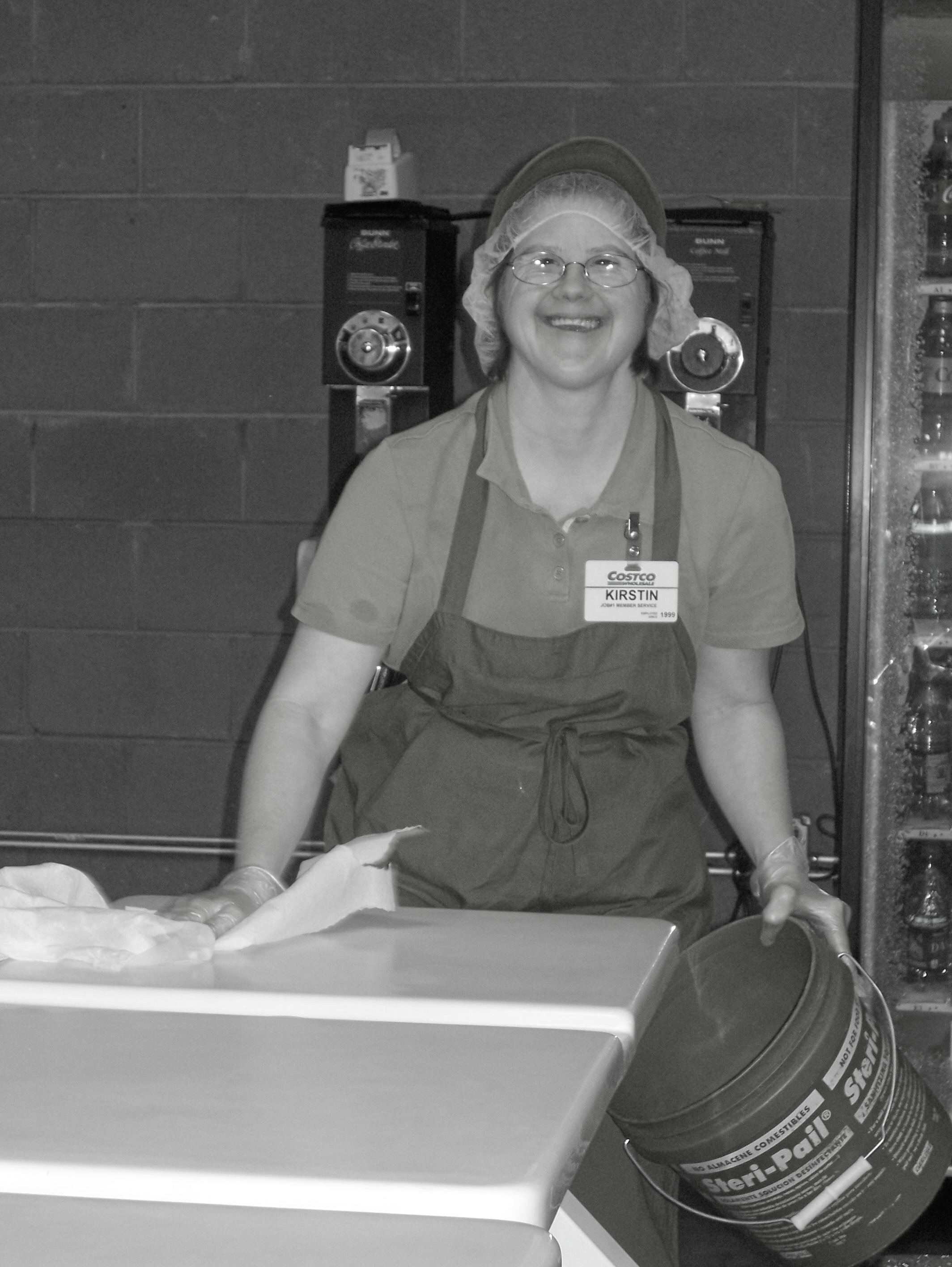
It’s five o’clock in the morning. I roll over in bed and remember that I am alone. Fifteen minutes later, Craig lies down next to me, fully clothed. He has just returned from the forty-five minute round-trip he makes each morning to take Kirstin to work. Her job in the bakery at Costco begins at 5 a.m. five days a week. Each morning Craig and Kirstin are up at 3:45, and by 4:30, they are on the road. This was our routine for the first six months that Kirstin worked at Costco. It was a miracle that she got that job in the first place. We weren’t about to mess it up.

After Kirstin had been working in the bakery for two months, Craig talked to the general manager to find out how she was doing. He said that she was not fast enough to meet the standard. They had decided to extend her probation period to 120 days, but he doubted that she would make it. He said that after that they would try her on some other jobs, such as folding clothes. If she couldn’t meet the standard there, they would have to let her go. It seemed that my worst nightmare was coming true.

I guess I forgot that this was Kirstin we were talking about. By the time she finished the first ninety days, she was meeting the standard and was off probation. She had made it over the first hurdle. At her first year anniversary, she was evaluated again. She had lots of room for improvement but was doing well enough to continue. She was given a raise to $10 an hour, but along with that came a new standard, sixteen boxes. This was a real challenge, but Kirstin was able to reach that one too.

Working in the bakery was hard work, but it was fun too. Kirstin’s coworkers accepted her as one of them from the start. They invited her to baby showers and going-away parties. They told her about their lives and their problems. Kirstin even went to a Country Thunder concert in Phoenix with Donna Rogers (her boss) and another coworker.

Even though Kirstin seemed to be doing well at work, in the back of my mind was still the thought that she might lose her job. Donna Rogers was transferred to Kansas City, and that meant Kirstin would have a new manager. This of course brought new fears. In fact she worked for several managers until there was a permanent one. Each manager had different ideas about how things needed to be done, and Kirstin constantly had to adjust. She had one manager who said, “There’s no crying in the bakery.”

Kirstin’s side of the story  I like to do my work every day, and I work hard at it. I like my boss, Kris. She helps me do a good job. I’ve had my job at Costco for a long time. That’s because I’m a good worker. I get a lot of compliments from the members. I care about all the people who come to my food court. I like to be helpful to people with disabilities.

There are some things I don’t like. I don’t like it when workers argue. I don’t like emptying the trash when it is heavy. But I do like getting paid every two weeks. I look at my pay stub on my computer to see how much money I make. I like getting benefits like health care and my 401k.

My advice to someone looking for a job is to be flexible and willing to help people when they need it. Don’t be afraid to learn new jobs. It makes you more valuable, and it’s job security.

From This Little Light of Mine: A woman with Down syndrome shines brightly in the world. Available on Amazon

Meet the Petersons

IMG_0388_edited-1Melissa Peterson is the tall, blond, fashion-conscious member of the Handy Helpers. She lives with her mother, Fran, grandmother, Sarah, and seven-year-old sister, Trisha. In books one and two, Melissa’s father, Cody, is in the army in Afghanistan. He returns home for good at the end of book two.

Melissa likes to be well-dressed. While her friends are happy to be comfortable in jeans and T-shirts, Melissa chooses to wear designer jeans and fancy tops. According to Melissa, no outfit is complete without lots of accessories. She dons a myriad of scarves, jewelry, belts, and boots. Amber’s mother calls it dressing to the nines. Amber suggests that sometimes Melissa is guilty of dressing to the eighteens or even the twenty-sevens.

Melissa is definitely the most rebellious of the Handy Helpers. She is the one who comes up the crazy ideas. Fortunately, Amber and Laura are there to rein her in at times. Melissa is an intelligent young lady, but is sometimes lazy, especially when it comes to school work. She should be an A student like Laura, but her procrastination often costs her in the grade department.

Melissa’s relationship with her sister Trisha is typical of many girls growing up. Unlike Melissa, Trisha is a good student. She does her homework every day and appears to be a the perfect child. But looks can be deceiving. Trisha has a mind of her own and can be very sneaky. This conversation between Trisha and Melissa from book two is one of my favorites.

“I have to borrow one of your Junie B. Jones books,” Melissa told her sister, Trisha, as she walked into her room. “I’m supposed to read to the first-grade class in the library on Friday.”

“I’m going to the library Friday,” Trisha said. “Are you going to read to my class?”

“Yeah, I’m reading to your class. Now where are the Junie B. Jones books?”

“They’re on the shelf over there, but you’ll have to pay me a dollar for rent.”

“What are you talking about?” Melissa said, upset. “I gave you those books. They were mine.”

“You gave them to me, so now they’re mine.”

“I’m not paying you anything.”

“Then you can’t use my book.”

“We’ll see what Mom has to say about it.”

“Oh, all right, but you better not mess it up.”

Melissa’s mother, Fran, is the manager of the Pizza Pan restaurant. She is a busy but involved mother. Fran is patient but firm with both her daughters. Melissa has a close relationship with her mother and feels comfortable confiding in her at times. But it is Melissa’s grandmother, Sarah, that Melissa turns to often when she is having problems. Melissa and her grandmother share a love of swimming. Sarah was on her college swim team and even had a chance to be in the Olympics. When Melissa joins the Special Olympics unified swim team in book three, Sarah volunteers to be the coach.

Sarah is a loving grandmother who is always there, but doesn’t intrude–at least not too often. In book two, Melissa is struggling with her jealousy over Beth Anne. Sarah offers some advice which Melissa immediately blows off with “You just don’t understand. I wish things could go back to the way they were before Beth Anne came.” Later in the book when Melissa comes to see things differently, she realizes that her grandmother was right all along.

Melissa’s relationship with her father is one of her biggest challenges. While her father was in Afghanistan, Melissa enjoyed a certain amount of independence permitted by her mother.  At first, Melissa was excited when her father returned home and even more excited that he wasn’t going back. But as time goes on, her feelings change. Unsure about his role in the family, Cody tries to put restrictions on Melissa. Of course she struggles against this and their relationship is strained. Fran points out to Melissa that when her father left she was a little girl like Trisha. It will take him time to adjust to the changes.  This will be an on-going challenge for Melissa in future books.

The Handy Helpers books are available on amazon

Bad News for Bullies


In Red, White, and . . . Bloopers! Spike’s life is made miserable by a bully–his sister’s boyfriend, Todd. Spike tries to tell his parents what is going on, but they think Spike is over-reacting. They point out that Todd has two older brothers and he is used to horsing around with them. Spike only has sisters. He isn’t accustomed to Todd’s rough-and-tumble ways. As he gets away with pushing Spike around, Todd becomes bolder, until he feels entitled to force Spike to clean up his messy kitchen.  Eventually, Spike and Todd are able to work through their problems and by the end of the book they are actually friends. Todd admits what he has been doing and Spike’s parents acknowledge that their lack of action caused Spike undue anguish and feelings of helplessness.

Bullying is identified as a serious problem in our world today. School children, teenagers, and even adults find themselves the victims of bullies. Bullies hold power over their victims, causing them to try to protect themselves any way they can. This protection could be in the form of avoidance, but in extreme cases, it could lead to someone taking his own life. Bullying in any form should be taken seriously. The signs of physical bullying are more obvious–bruises or other injuries that are frequent, or not the result of normal play. The effects of emotional bullying are less obvious. Someone who is being repeatedly humiliated feels the pain as much as someone who is hit.

Parents and teachers should be the first line of defense in protecting children from bullies. Educating themselves to recognize the signs of bullying is the first step. Having an open relationship where a child feels comfortable talking to parents about their problems is vital.

In a HuffingtonPost article, posted October 17, 2013, and updated January 23, 2014, Franklin Schargel, a former teacher, school counselor and administrator, offered these suggestions to parents if you think your child is being bullied:

1.  Talk to your child about what happened. Listen to the whole story without interrupting. Be calm and validate what is being said. Remind your child that it is normal to feel upset but it is never all right to be bullied. Ask your child what he/she would like to happen, before you make any suggestions.

2.  Don’t expect your child to solve things on their own.

3.  Deal with each incident consistently. Never ignore or downplay complaints about bullying.

4.  Keep a log of the incidents, where the bullying took place, who was involved, how frequently, if anyone witnessed it. Do not attempt to confront the person or their family yourself.

5.  Contact the school. Find out if the school has an anti-bullying policy. Find out if the school is aware of the bullying and whether anything is being done to address the situation. Make an appointment to speak to a school counselor or school administrator.

6.  If your child asks to stay home from school, explain that it won’t help and it may make things worse.

7. Discuss bullying at school board meetings and with other parents (i.e.PTA).

Schargel goes on to say, “Schools need to assertively confront this problem and take any instance of bullying seriously. Addressing and preventing bullying requires the participation of all major school constituencies, school leaders, teachers, parents and students. By taking organized schoolwide measures and providing individuals with the strategies to counteract bullying schools can reduce the instances of bullying and be better prepared to address it when it happens.”

http://www.huffingtonpost.com/franklin-schargel/bullying-what-schools-par_b_4103901.html

Cyberbullying can be even more vicious than the typical forms of bullying because it is shared with people outside the group involved in the bullying. We must all guard against aiding the cyberbully by being careful what we share on social media. Giving our support to efforts in schools, workplaces and on social media to prevent bullying is everyone’s responsibility.

The Handy Helpers: Red, White, and . . . Bloopers! is available on amazon


Written by Rosemary Heddens